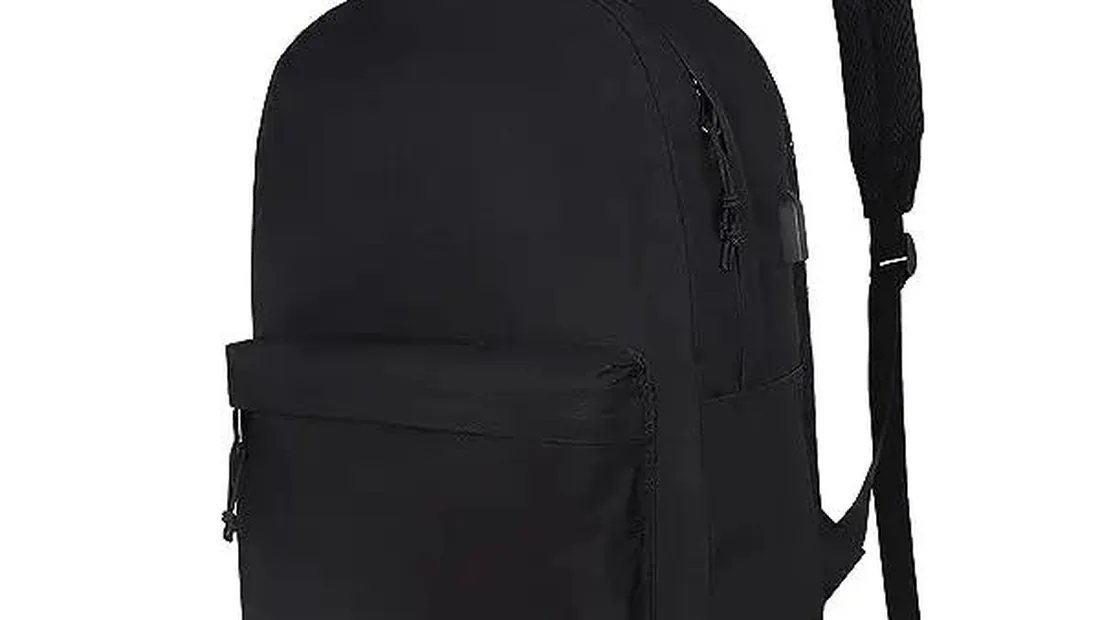
Backpacks types split into more categories than most buyers expect. The term covers a frameless mesh cinch bag and a 40-liter internal-frame travel pack. Structurally they have almost nothing in common. The carry system changes. The capacity changes. The buyer changes. If you source bags by marketing label alone, you will order the wrong construction.
This guide sorts backpack types by use case and structure. It is written for brand owners and procurement buyers who need to specify a product, not browse a catalog. For each category we cover what defines it, the capacity range you will see in practice, the carrying system it needs, and who actually buys it.
Daypacks
A daypack is a compact backpack for daily use or short activities. The industry definition is loose, but the structure is not. Most daypacks are frameless or semi-structured. They have one main compartment, a quick-access front pocket, and enough padding to protect a tablet or a light layer. They are not built for heavy loads.
Capacity runs small, roughly 10 to 20 liters in most lines. The shoulder straps are lightly padded. There is no hip belt on most models, and if one exists it is a narrow webbing strap that does not transfer load. The back panel is usually a foam sheet with a mesh facing.
Who buys daypacks? Promotional brands, streetwear labels, festival merchandise companies, and corporate gifting programs. The MOQ is low, decoration is easy, and the product photographs well. A buyer ordering 800 units in three colors wants a simple construction that will not generate returns.
Do not overbuild a daypack. A stiff frame sheet adds cost and weight the customer will not value. A padded laptop sleeve adds structure the bag does not need. Keep the spec lean.
School Backpacks
A school backpack carries books, stationery, lunch, and personal items. That sounds simple. The abuse is not. These bags get dropped on pavement, dragged by one strap, and overloaded past any stated capacity. The construction has to survive a student, not a commute.
Capacity typically lands between 20 and 35 liters. The main compartment is deep. A padded laptop sleeve is now standard even in elementary lines. The base is reinforced. The straps are padded and sewn into the back panel with a box-X anchor. Reflective details are common. See our school backpack page for the full construction breakdown.
The carrying system matters more here than on a daypack. Shoulder strap anchors take repeated peak loads. The grab handle gets yanked. The base seam wears first. A school backpack without a reinforced base will fail within one school year.
Buyers are school districts, uniform suppliers, licensed character brands, and stationery chains. They order by the container. They care about failure rates more than feature lists. One torn strap on a social media post costs more than the bag.
Laptop and Commuter Backpacks
A laptop backpack is defined by its protected device compartment. The sleeve is padded, suspended above the base, and sized to a specific device class. The rest of the bag is secondary. Cable organization, accessory pockets, and a clean silhouette all serve the commute.
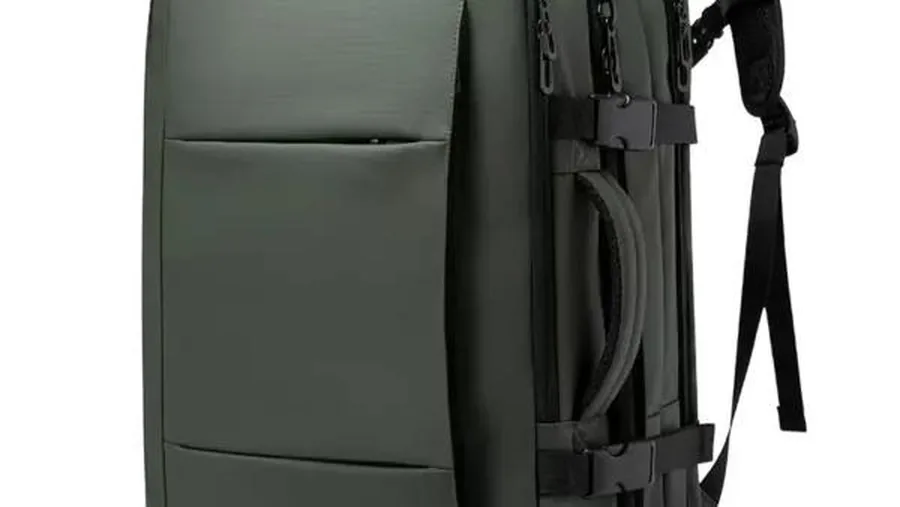
Capacity runs 18 to 30 liters for most commuter lines. The laptop compartment is separate from the main cavity. The suspension gap at the bottom is critical. A laptop that touches the base panel absorbs every drop impact. See our laptop backpack page for sleeve dimensions and protection details.
The carrying system on a commuter backpack is semi-structured. A frame sheet or dense foam panel keeps the bag upright on the train. Sternum straps appear on larger models. A luggage pass-through strap is now expected on any commuter bag over 20 liters.
The buyer is a tech accessory brand, a corporate gifting program, or an office goods retailer. Corporate buyers want a clean logo area and a conservative color block. Tech brands want cable routing and a suspended sleeve. Both want the laptop to survive a fall.
Travel and Carry-On Backpacks
A travel backpack is built for transit, not trail. It opens like a suitcase on most modern designs. The main cavity is panel-loading rather than top-loading. Compression straps keep the load from shifting in an overhead bin. The dimensions are planned around airline carry-on limits, though the exact allowance varies by carrier, so check current IATA guidance before you commit to a size.
Capacity runs 30 to 45 liters for carry-on models. The harness is stowable on many designs. Shoulder straps zip behind a panel so the bag can be checked without snagging. A hip belt appears on larger travel packs, but it is often removable.
Travel backpacks need a frame sheet or internal stays. A 40-liter load without structure becomes a sagging tube. The back panel needs ventilation. The grab handles need to be sewn into load-bearing seams, not tacked on as decoration. See our travel backpack page for the full specification.
Buyers are travel goods brands, luggage companies expanding into soft goods, and crowdfunded product lines. They order in smaller runs than school backpack buyers but demand more hardware options and more colorways.
Hiking and Load-Carrying Packs
An outdoor backpack transfers load to the pelvis. That is the defining feature. The hip belt is padded and structural. The frame, whether internal stays or a frame sheet, directs weight downward. Shoulder straps stabilize the load. They do not carry it alone.
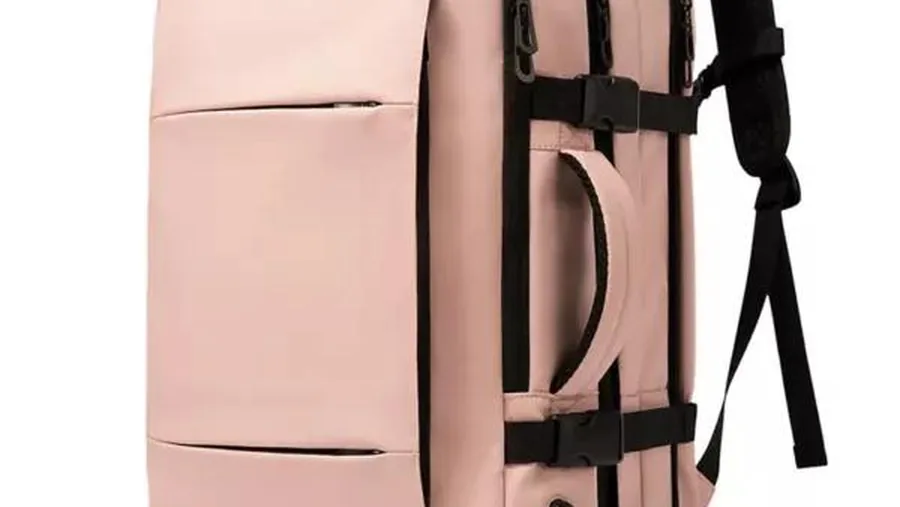
Capacity runs from 20 liters for a summit pack to over 65 liters for a multi-day pack. Torso length becomes a fit dimension. The back panel uses foam channels or mesh for ventilation. Compression straps control load shift. Load lifters adjust the angle between the strap and the bag body.
This is the most expensive category to build. The harness is a system, not a strap. Every anchor point takes repeated peak loads. The fabric needs weather resistance. The hardware needs to survive cold, abrasion, and UV.
Buyers are outdoor brands, hunting and fishing labels, and military surplus distributors. They know the category. They will ask about frame construction, hip belt padding, and fabric denier. A generic answer loses the order.
Drawstring Cinch Packs
A drawstring backpack is a fabric sack with two cord loops that serve as shoulder straps and closure. There is no zipper. There is no frame. There is no padding. The bag is the simplest backpack type in this guide.
Capacity is under 15 liters on most models. The fabric is often mesh, ripstop nylon, or lightweight polyester. The cord runs through a hem channel at the top and exits through reinforced eyelets at the bottom corners. Pull the cords and the bag closes and forms the straps at the same time.
Buyers are event organizers, gym chains, sports teams, and promotional product distributors. The MOQ is low. Decoration is a one-color print. The unit cost is the lowest of any backpack type. See our drawstring mesh backpack page for fabric and cord options.
Rolling Backpacks
A rolling backpack is a hybrid. It has shoulder straps and wheels. The telescoping handle is housed in a rigid or semi-rigid back panel. The wheels are inline skate wheels or larger roller wheels mounted on a base frame.
The structural challenge is the wheel base. The bag body must hold its shape when rolled. A floppy pack drags on the ground. The telescoping handle needs a channel sewn into the back panel. The base needs a rigid plate. All of this adds weight.
Capacity runs 20 to 35 liters. The carrying system is compromised by the wheel hardware. Shoulder straps are thinner and less padded because the bag is expected to roll most of the time. Buyers are school bag brands, travel goods companies, and medical equipment suppliers. The category is smaller than it looks. Most consumers choose either a backpack or a wheeled case, not the hybrid.
Specialty Packs: Camera, Tool, Cooler
Specialty backpacks are built around a payload, not a user. A camera backpack has padded dividers and side access. A tool backpack has a wide mouth opening, a stiff base, and internal pockets sized for hand tools. A cooler backpack has an insulated compartment and a leak-resistant liner.
The carrying system follows the payload weight. A loaded tool backpack can exceed 15 kilograms. That requires a hip belt and a frame sheet. A camera backpack with 8 kilograms of gear needs a suspended base and dense padding. A cooler backpack is lighter but the insulation layer changes the construction.
Capacity varies too widely for a single range. The buyer is a niche brand: photography accessory companies, trade tool manufacturers, outdoor cooler labels. These buyers know their payload. They will give you the weight, the dimensions of the largest item, and the access pattern. Build to that.
Structural Systems Behind the Categories
Every backpack type sits on one of four structural systems. The choice drives cost, weight, and load behavior.
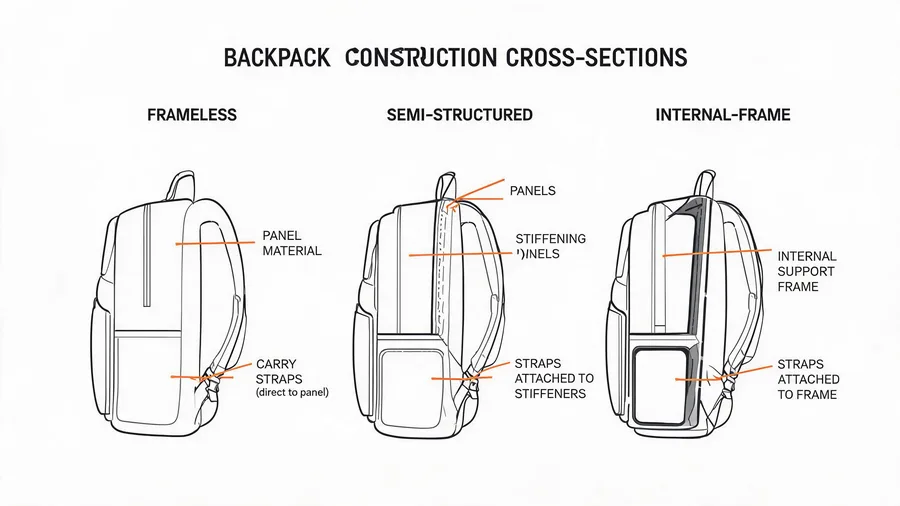
- Frameless construction. The bag body and padding provide shape. No rigid load-transfer structure. Common in daypacks, drawstring packs, and lightweight promotional bags.
- Frame sheet. A semi-rigid sheet inside the back panel limits collapse and spreads pressure. Standard in laptop backpacks and mid-size travel packs.
- Internal stays. Narrow rigid elements that support vertical load transfer. Found in larger travel packs and hiking packs where the hip belt must work.
- Semi-structured body. Foam, board, piping, or laminated panels create shape without a full frame. Used in school backpacks and rolling packs.
The system is not a marketing label. It is a bill of materials decision. A frameless 30-liter pack will sag. An internal-frame 15-liter pack is overbuilt. Match the system to the load.
How Capacity Maps to Dimensions
Capacity is internal volume, not exterior size. A 20-liter pack can be tall and narrow or short and deep. The shape changes how the bag carries. A tall narrow pack sits close to the back. A deep pack pulls the load away from the body and increases leverage.
Height, width, and depth are measured from specified reference points. The gusset or side panel controls depth. Opening length is a separate measurement from capacity. A bag can have a 30-liter volume and a 40-centimeter zipper opening. The two numbers are not interchangeable.
When you spec a backpack, give the factory all four numbers: height, width, depth, and capacity. Give the tolerance. Give the measurement method. A dimension without a reference point is a guess.
Comparison Table
| Backpack type | Typical capacity | Structural system | Carry system | Primary buyer |
|---|---|---|---|---|
| Daypack | 10, 20 L | Frameless or semi-structured | Lightly padded straps, no hip belt | Promotional and streetwear brands |
| School backpack | 20, 35 L | Semi-structured | Padded straps, reinforced base, sternum strap optional | School districts, licensed brands |
| Laptop backpack | 18, 30 L | Frame sheet or semi-structured | Padded straps, suspended laptop sleeve, luggage pass-through | Tech accessory and corporate gifting |
| Travel backpack | 30, 45 L | Frame sheet or internal stays | Stowable harness, removable hip belt, compression straps | Travel goods and luggage brands |
| Hiking pack | 20, 65+ L | Internal stays | Structural hip belt, load lifters, ventilated back panel | Outdoor and tactical brands |
| Drawstring pack | Under 15 L | Frameless | Cord straps, no padding | Events, gyms, promotional distributors |
| Rolling backpack | 20, 35 L | Semi-structured with rigid base | Thin straps, telescoping handle, wheel frame | School and travel goods brands |
| Specialty pack | Varies by payload | Varies by payload weight | Matched to payload: hip belt, frame sheet, or dense padding | Camera, tool, and cooler niche brands |
Choosing the Right Type for Your Line
Start with the load. What does the end user carry, how heavy is it, and how far does it travel? That tells you the structural system. The marketing label comes later.
A brand that sells commuter bags to office workers needs a frame sheet and a suspended laptop sleeve. A brand that sells festival merch needs a frameless drawstring pack at the lowest possible unit cost. Both are backpacks. The specs are opposites.
Tell your factory the use case first. Give the payload weight, the largest item dimensions, the target price band, and the order quantity. A good factory will then recommend the structural system and the carry system. A bad one will ask what color you want.
If you are still narrowing down materials, our rPET backpack page covers recycled fabric options that work across most categories. For a full custom specification, start at the contact page and send your target payload and quantity.
Frequently Asked Questions
What is the difference between a daypack and a school backpack?
A daypack is smaller, usually 10 to 20 liters, and built for light daily loads. A school backpack runs 20 to 35 liters, has a reinforced base, padded straps, and a laptop sleeve. The school bag is built to survive more abuse.
How do I choose a backpack type for my brand?
Define the end user's payload first. Weight, largest item, and carry distance determine the structural system. Then match the type: light loads suit daypacks or drawstring packs, heavy loads need a frame sheet or internal stays and a hip belt.
What capacity should a laptop backpack have?
Most commuter laptop backpacks run 18 to 30 liters. The device compartment matters more than total volume. The sleeve must be padded, suspended above the base, and sized to the specific laptop class you are targeting.
Why do hiking backpacks cost more to manufacture?
The harness is a system, not a strap. A structural hip belt, load lifters, internal stays, and a ventilated back panel all add components and labor. Every anchor point must survive repeated peak loads, so materials and stitching are heavier.